
Audient iD14 MKII Review

Disclosure: I may earn a commission from purchases made through affiliate links, at no extra cost to you. Affiliate Disclosure
In this Audient iD14 MKII review, I’m going to determine if this interface is a good choice for the mid-range market.
The iD14 MKII is not a beginner interface. It ‘s not trying to be the cheapest option on the shelf. Instead, it is built for the producer, guitarist, or podcaster who is ready to take their recordings to the next level without spending $1,000 on a professional-grade setup.
I’m going to break down everything you need to know about the Audient iD14 MKII. I will also cover the preamp quality, build, software bundle, the hidden features most reviewers skip, and most importantly, whether it is actually worth your money.
Let’s get into it!
Key Specifications
Specifications | Detail |
Inputs | 10 (2 XLR/TRS combo, 1 JFET DI, 8 via ADAT) |
Outputs | 6 (2 monitor, 2 headphone, 2 via S/PDIF) |
Mic Preamps | 2 Console-Grade Class-A Preamps |
JFET DI | Yes (Front Panel) |
Sample Rate | Up to 96kHz / 24-bit |
Connectivity | USB-C |
ADAT Expansion | Yes (8 extra channels via optical) |
ScrollControl | Yes |
Phantom Power | Yes (48V) |
Compatibility | Mac, Windows, iPad (with powered hub) |
Weight | 766 grams (1.69 lbs) |
Dimensions | 173(w) x 120(d) x 62(h) mm (6.81″ x 4.72″ x 2.44″) |
Build | All-metal chassis |
Price | $225–$295 |
Build Quality & Design
The first thing you will notice when you take the Audient iD14 MKII out of the box is how solid it feels.
While most interfaces in this price range are made from plastic, the iD14 MKII features an all-metal chassis. It feels dense, heavy, and genuinely premium. This is the kind of build quality that makes you feel like you made a smart investment the moment you hold it in your hands.
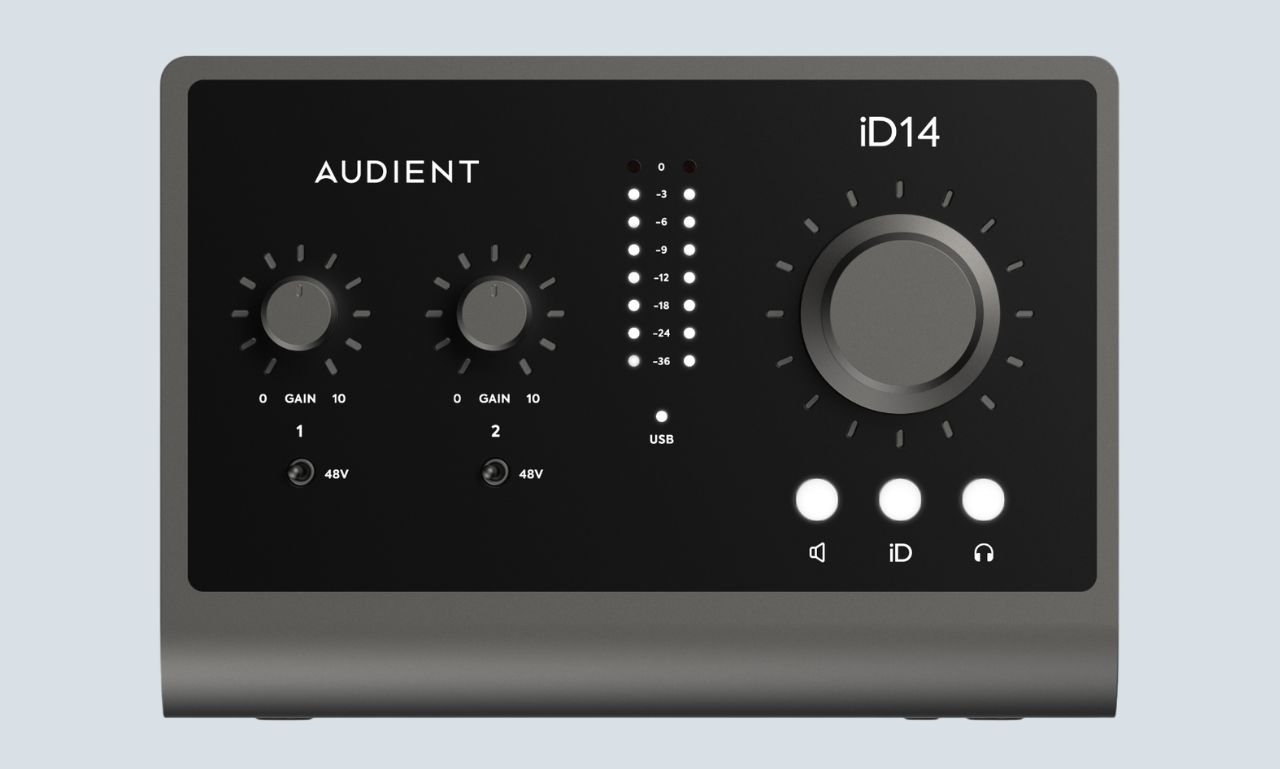
➤ Front Panel Layout
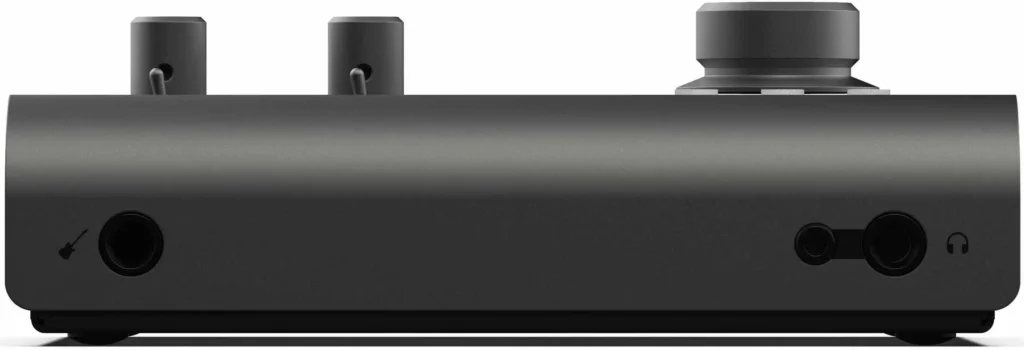
The front panel is clean and intuitive:
- 2 XLR/TRS Combo Inputs: For your microphones and line-level instruments.
- JFET DI Input: A dedicated high-impedance input for guitars and basses.
- Headphone Output: With its own dedicated volume knob.
- Large Monitor Volume Knob: Controls your studio monitor output.
- Input Gain Knobs: One per channel, with LED metering.
- 48V Phantom Power Button: For condenser microphones.
- ScrollControl Encoder: The hidden gem we will discuss in detail.
➤ Back Panel Layout
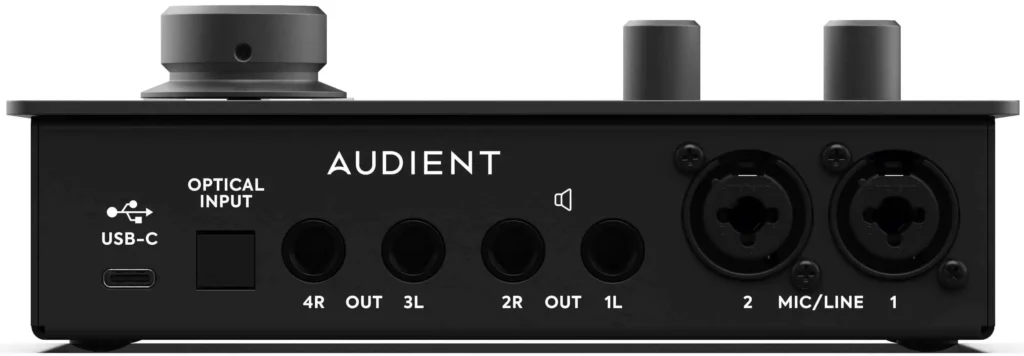
The back panel gives you everything you need for a complete studio setup:
- 2 TRS Monitor Outputs: For your studio monitors.
- ADAT Optical Input: For expanding to 10 channels.
- S/PDIF Input/Output: For digital devices.
- USB-C Port: For connecting to your computer.
➤ The ScrollControl Feature
This is one of the most underrated features of the iD14 MKII, and most reviewers barely mention it.
The ScrollControl encoder on the front panel essentially turns your interface into a hardware controller for your DAW. When you activate ScrollControl mode, the large encoder on the interface controls whatever your mouse is hovering over on your screen.
What does that mean in practice?
- Hover over a plugin knob and turn the encoder to adjust it with precision.
- Hover over a DAW fader and control the volume without touching your mouse.
- Hover over a pan knob and dial it in perfectly.
It sounds like a small feature, but once you start using it, going back to a standard interface without it feels limiting. It genuinely speeds up your workflow.
Preamp Quality
Let’s talk about the most important part of any audio interface review: how does it actually sound?
The answer: The Audient iD14 MKII is exceptional for its price range!
➤ Why Audient Preamps Are Different?
Most budget and mid-range interfaces use generic, off-the-shelf preamp chips. They work fine, but they have limitations, primarily in terms of noise, headroom, and transparency.
Audient takes a different approach. The preamps in the iD14 MKII are based on the Class-A discrete circuit design from their professional ASP8024 console. Class-A circuits are inherently more linear, which means they introduce less coloration and distortion into your signal.
Your recordings will sound more accurate, more natural, and more professional.
➤ Real-World Performance
Here is how the iD14 MKII preamps performed in real-world recording scenarios:
Vocals:
The preamps handle vocals beautifully. There is a warmth and clarity to the high end that you simply do not get from a budget interface. Dynamic microphones like the Shure SM7B (which require a lot of gain to sound their best) shine through the iD14 MKII preamps without the noise floor becoming an issue. Condenser microphones like the Audio-Technica AT2020 sound open, airy, and detailed.
Acoustic Guitar:
Acoustic guitar recordings through the iD14 MKII have a natural, organic quality. The transients are preserved beautifully, meaning the attack of each note comes through clearly without any smearing or distortion.
Electric Guitar (via JFET DI):
This is where things get really interesting, but we have a dedicated section for the JFET DI coming up.
Podcasting & Voiceover:
If you are a podcaster or voiceover artist, the iD14 MKII is one of the best interfaces you can buy at this price. The low noise floor means your recordings are clean and professional without needing heavy noise reduction in post-production.
➤ Noise Floor Comparison
One of the most measurable differences between budget and mid-range interfaces is the Equivalent Input Noise (EIN), essentially how much noise the preamp adds to your signal.
Interface | EIN (Lower is Better) |
Audient iD14 MKII | -129 dBu |
Focusrite Scarlett 4i4 | -127a dBu |
Behringer UMC202HD | –129 dBu |
Universal Audio Volt 276 | -127 dBu |
The iD14 MKII sits right at the top of the class, delivering a noise floor that rivals interfaces costing twice as much.
The JFET DI Input
If you are a guitarist, this section is for you.
Most audio interfaces include a standard Hi-Z (high impedance) input for direct guitar recording. These inputs work, but they sound sterile and flat. They do not capture the natural interaction between a guitar pickup and an amplifier input, the slight compression, the warmth, or the character.
The Audient iD14 MKII takes a completely different approach with its JFET DI input.
➤ What Is JFET Technology?
JFET stands for Junction Field-Effect Transistor. In simple terms, it is a circuit topology that mimics the electrical characteristics of a real valve (tube) amplifier input. When you plug your guitar into a JFET DI, the circuit responds to your playing dynamics in a way that a standard Hi-Z input simply cannot replicate.
The result is a warmer, more organic direct guitar tone that sits better in a mix and responds more naturally to your playing dynamics.
➤ Why This Matters for Your Productions?
Recording guitars directly (without a microphone and amp) is standard practice in modern home studio production. The quality of your DI signal directly affects how good your final guitar tone will sound, even when you run it through an amp simulator plugin afterward.
A better DI signal going into your amp sim plugin means a better, more realistic guitar tone coming out.
Pro Tip: Plug your guitar into the JFET DI on the iD14 MKII and combine it with a free amp simulator like Neural Amp Modeler (NAM) for a professional guitar tone without spending a single dollar on a microphone or physical amplifier.
Software Bundle: What Do You Get?
Every audio interface comes with a software bundle these days, and the iD14 MKII is no exception. Here is exactly what you get in the box:
Software | What It Is |
Ableton Live Lite | Entry-level version of the industry-standard DAW |
Pro Tools Intro | Free version of Avid’s professional DAW |
Plug-In Collective | Access to rotating free and discounted plugins from top brands |
Loopcloud 3 Months | Access to a massive library of royalty-free samples and loops |
➤ Honest Assessment of the Bundle
The bundle is solid, particularly for beginners who do not yet own a DAW. Having both Ableton Live Lite and Pro Tools Intro gives you two of the industry’s most respected DAWs to experiment with.
However, if you compare it to the Arturia MiniFuse bundle, which includes Analog Lab with hundreds of premium synth sounds, the iD14 MKII’s bundle feels slightly less impressive on paper.
That said, the Plug-In Collective is a genuinely valuable ongoing benefit. Audient regularly partners with top plugin developers to offer exclusive free plugins and discounts to iD14 MKII owners, so the value of the bundle grows over time.
ADAT Expansion
This is the feature that separates the iD14 MKII from most of its competitors, and it is one that most people do not think about until they need it.
➤ What Is ADAT?
ADAT is a digital audio protocol that allows you to send up to 8 channels of audio through a single optical cable. By connecting an ADAT-equipped preamp expander to the optical input on the back of your iD14 MKII, you can instantly expand your interface from 2 microphone inputs to 10 microphone inputs.
➤ Why Does This Matter?
Currently, you might only need 2 inputs. You are recording vocals, guitar, and maybe a keyboard. 2 inputs is plenty.
But what happens in 6 months when you want to record a live drum kit? A standard drum recording requires at least 6 to 8 microphones simultaneously. Without ADAT expansion, you would need to buy an entirely new interface.
With the iD14 MKII, you simply add a budget ADAT preamp expander like the Behringer ADA8200, and suddenly you have a 10-input recording system for a fraction of the cost of buying a new interface.
This is the hidden value of the iD14 MKII. It grows with your studio instead of holding it back.
Audient iD14 MKII vs. Main Competitors
How does the iD14 MKII stack up against its main competitors in 2026?
Feature | Audient iD14 MKII | Focusrite Scarlett 4i4 | Universal Audio Volt 476 | Motu M4 |
Preamp Quality | ⭐⭐⭐⭐⭐ | ⭐⭐⭐⭐ | ⭐⭐⭐⭐ | ⭐⭐⭐⭐ |
Build Quality | ⭐⭐⭐⭐⭐ | ⭐⭐⭐⭐ | ⭐⭐⭐⭐⭐ | ⭐⭐⭐⭐ |
JFET DI | ✅ Yes | ❌ No | ❌ No | ✅ Yes |
ADAT Expansion | ✅ Yes | ❌ No | ❌ No | ❌ No |
ScrollControl | ✅ Yes | ❌ No | ❌ No | ❌ No |
Onboard DSP | ❌ No | ❌ No | ❌ No | ❌ No |
Noise Floor (EIN) | -129 dBu | -127 dBu | -127 dBu | -129 dBu |
Phantom Power | ✅ Yes | ✅ Yes | ✅ Yes | ✅ Yes |
Headphone Amp Quality | ⭐⭐⭐⭐⭐ | ⭐⭐⭐⭐ | ⭐⭐⭐⭐⭐ | ⭐⭐⭐⭐ |
Verdict | Best Preamps & Features | Best for Beginners | Best for Vintage Sound | Best Metering |
Who Should Buy The Audient iD14 MKII?
✅ Buy It If You Are:
- A home studio producer who has outgrown a budget interface and is ready to upgrade.
- A guitarist who wants the best possible direct recording tone via the JFET DI.
- A podcaster or voiceover artist who needs a clean, low-noise recording chain.
- A semi-pro producer who wants a future-proof setup with ADAT expansion capability.
- Someone who values build quality and wants an interface that will last for years.
- A producer who works with dynamic microphones like the Shure SM7B that require high-quality preamps with plenty of gain.
❌ Skip It If You Are:
- A complete beginner on a tight budget, the Focusrite Scarlett 2i2 is a better starting point.
- A live performer who needs a portable, bus-powered interface.
- A producer who needs onboard DSP for zero-latency monitoring should look at the Universal Audio Apollo Twin or the RME Babyface Pro FS instead.
🛒 Where To Buy it?
👉 Check Current Price on Amazon
FAQ:
How many channels can I record at once?
Out of the box, you can record 2 simultaneous microphone channels. With an ADAT preamp expander connected to the optical input, you can expand this to 10 simultaneous input channels.
What microphone should I pair with the Audient iD14 MKII?
The iD14 MKII pairs beautifully with a wide range of microphones. For vocals, the Shure SM7B (dynamic) and the Audio-Technica AT2020 (condenser) are excellent choices. For acoustic guitar, the Rode NT1 is hard to beat.
Does the Audient iD14 MKII work with an iPad or iPhone?
Yes, the iD14 MKII can work with an iPad via USB-C, but you may need a powered USB-C hub depending on your iPad model. It is not officially designed as a mobile interface, so your experience may vary.
Is The Audient iD14 MKII Worth It?
If you are a serious home studio owner who is ready to stop settling for mediocre recordings and start producing at a professional level, the Audient iD14 MKII deserves to be at the top of your shortlist.
➤ You Might Also Like:
- 10 Best Budget Audio Interfaces in 2026
- Valhalla Supermassive Review
- TDR Nova Review
- 10 Best Free Saturation VST Plugins
- 12 Best Free Reverb VST Plugins

Amine Fariss is the founder of AudioPluginList and has been producing music since 2005. He writes about audio plugins and music production equipment, combining hands-on testing with research from official sources.
Nice to see a new Blog for free music software. Your hints and tips are really beginner friendly. The anounced audiointerfaces and ratings are real, not marketing influenced 👍is what I can say from my perspective with Audient and Behringer and Focusrite Interfaces
Started with a STA Audio/Hoontech PCI device in 2001 and after Emu, Audient, Zoom I’m landed in the pro range of RME Audio with the Babyface pro.
RME converters are a bit better than the ID14mk2 ones but Not that much, but the headphone amp of the Audient ist still outstanding for this low price.
A friend of mine are really happy with the ID14mk2 and extended it with Behringer’s ADA8200 for his synths.
As well my personal music buddy, that i gave my EVO4 for his new mac Mini m4 are totally blown away by the soundquality and latency for such a low price.
Cool Blog, but where I can find your music Amine Fariss?
Thanks so much for the feedback! I’m glad you find the tips beginner-friendly. I always aim for honest, unbiased reviews, so your perspective means a lot.
You’ve got a wonderful gear history! The RME Babyface Pro is an absolute beast for latency and stability, but you are totally right! Audient really punches above its weight class with those headphone amps and preamps.
To answer your question, my 20+ years in the industry are focused strictly on engineering, mixing for clients, and sound design, so I don’t release commercial music under my name. This platform is where I share those behind-the-scenes insights.
Thanks again for stopping by and sharing your experience! 🎹