

Valhalla Freq Echo Review

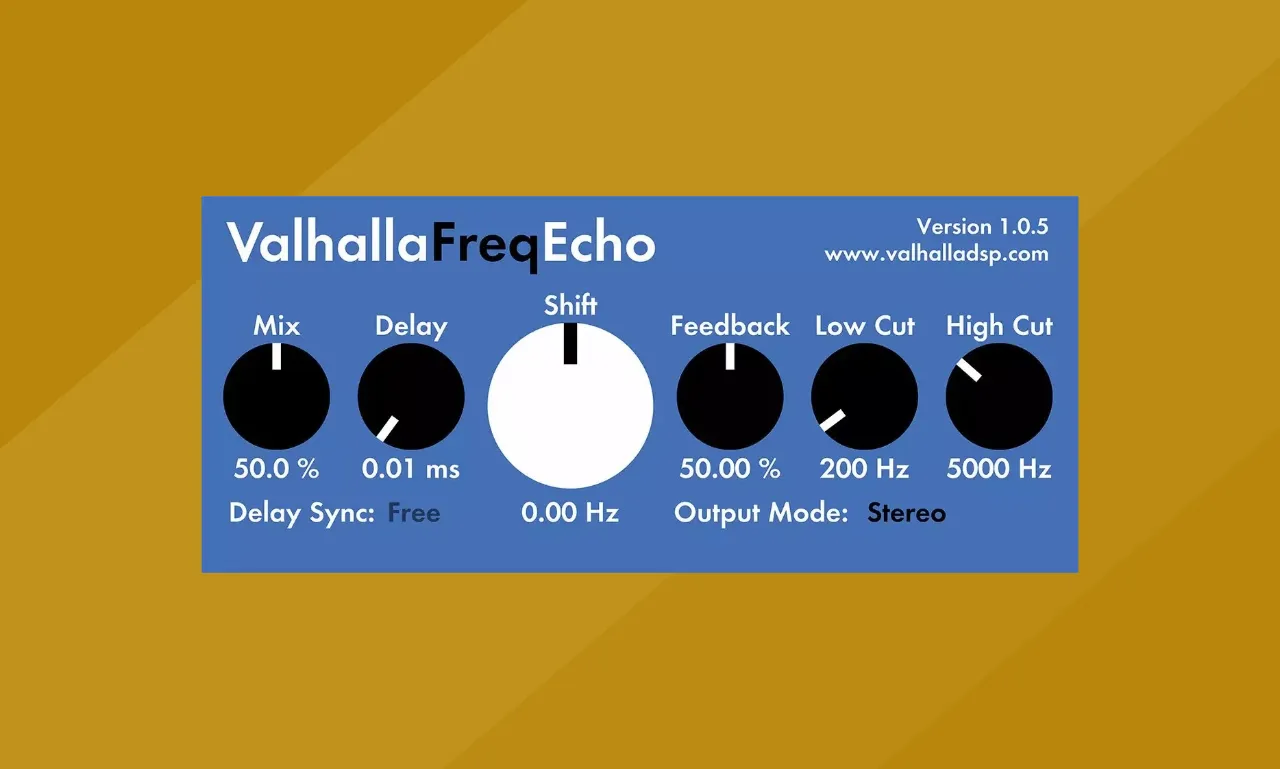
Valhalla Freq Echo is a free delay plugin that combines frequency shifting with analog-style echo. Unlike a conventional delay that repeats the original sound, it can change the character of each repeat, creating everything from subtle movement to unusual, evolving effects.
The plugin is useful for producers who want to experiment with synths, guitars, vocals, and other sounds. Its frequency-shifting effect can add movement and transform ordinary delay repeats into more experimental textures.
In this review, I’ll look at its main features, controls, sound, and practical uses to help you decide if Valhalla Freq Echo is a useful addition to your plugin collection.
Review Overview
Pros & Cons
What Does Valhalla Freq Echo Do?
Valhalla Freq Echo combines frequency shifting with echo, changing the tone of the sound as it repeats. Frequency shifting moves each frequency component up or down by a fixed amount in hertz, rather than shifting all pitches by the same musical interval.
How frequency shifting works with echo
Valhalla Freq Echo accepts mono or stereo input and produces stereo output. The frequency shifter also affects the feedback loop, so each repeat can develop a different tone as the echo continues.
From subtle motion to extreme effects
Valhalla describes Freq Echo as suitable for dub and psychedelic effects. Its combination of frequency shifting and echo can produce a wide range of sounds, from subtle movement to more experimental textures.
With subtle settings, Freq Echo can create gentle chorusing or a double-tracking effect, adding movement without making the delay too noticeable.
More pronounced settings can create barberpole phasing and flanging, where the tone seems to move continuously. Stronger processing can also produce endless glissandos or runaway echoes.
How Do the Controls Shape Timing and Feedback?
Start with a short phrase, keep the feedback low, and gradually increase the frequency shift and delay time. This helps you hear how each control changes the repeats.
Choose tempo sync or Free mode
Tempo-synchronized delay follows the session beat, while Free mode runs independently of song tempo. Use Sync for beat-aligned repeats or Free mode when you want to set the delay time independently of the session tempo.
Shape, automate, and capture the repeats
The high-pass and low-pass filters shape the feedback path by controlling which frequencies remain in the repeats. You can also hover over a control to see a tooltip explaining its function.
You can automate the frequency shift, delay time, and feedback to create changing effects. For example, gradually increasing the shift can make the repeats sound more unusual, while adjusting the delay time changes their timing.
Increasing feedback produces more repeats and makes the effect last longer. At very high settings, it can create self-oscillation, producing sustained tones that continue to evolve.
When using Valhalla Freq Echo on a send and return, set the Mix control to 100% wet so you can balance the effect separately from the original signal.
Formats and Compatibility
Valhalla Freq Echo is available for Windows and macOS as a 64-bit plugin. Supported formats include VST, VST3, AAX, and AU, depending on the operating system. Version 1.2.8 includes native macOS builds for Intel and Apple Silicon processors (M1 through M5). The plugin is free and does not require an iLok account or license activation.
Frequently Asked Questions
Will a frequency shift stay in key across different notes?
No, a fixed-hertz shift does not preserve the same musical interval across different notes. A frequency shifter moves every component by the same number of hertz, so the pitch change varies with the note. Judge the result against the arrangement, especially when the part carries clear melody or harmony. A small shift may blend more easily than a large one.
Can Valhalla Freq Echo replace a conventional delay on every track?
No, Valhalla Freq Echo is not the best replacement for a conventional delay on every track. Its frequency shifts and changing repeats suit sound design, but they can draw attention away from a part. A cleaner delay is generally easier to keep unobtrusive in a busy mix. Use the effect when its changing tone supports the musical role.
How do you control self-oscillation in Valhalla Freq Echo?
Keep the feedback level low enough to control the repeats. If the effect starts producing a long, continuous sound, reduce the feedback. You can also record the result to a separate track, giving you more control to edit, shorten, or process the effect without changing the original recording.
Do you need to automate multiple controls to create movement?
No, a small amount of automation on frequency shift or delay time can create movement. Feedback automation changes how long the tail persists, so it can add a clear rise or fade without moving every control. Start with one parameter and listen to the result before adding another. This keeps the change easier to shape in a busy arrangement.
Can Valhalla Freq Echo work well on drums and percussion?
Yes. Valhalla Freq Echo can add unusual textures and movement to drums and percussion. A subtle frequency shift combined with short delay times can create metallic, resonant effects, while higher feedback settings produce more experimental results. It can work particularly well on snares, hi-hats, and percussion loops when you want something different from a conventional delay.
Final Thoughts
Valhalla Freq Echo is a useful creative effect for producers who want more than conventional delay repeats. Its combination of frequency shifting and echo makes it suitable for adding movement to synths, guitars, vocals, and other sounds.
It's not designed to replace a traditional delay for every mixing task. However, its unusual effects make it worth adding to your collection if you enjoy experimenting with sound design.
➤ You Might Also Like
- 6 Best Free Delay VST Plugins
- Valhalla Supermassive Review
- 12 Best Free Reverb VST Plugins
- Softube Saturation Knob Review
- 10 Best Free Synth VST Plugins

Amine Fariss is the founder of AudioPluginList and has been producing music since 2005. He writes reviews and guides about audio plugins and music production equipment, using his own experience with music production and information from official product documentation.